
Home

On Disciplined Reading

Jun 9th, 2009 by Bruce Ashford Print This Post

“Of making many books there is no end.” (Ecc 12:12)

There are three types of people in our country. There are, first of all, those who do not read. An AP-Ipsos poll recently revealed that 25% of Americans do not read books, while other polls have put the number higher, at around 50%. It is not that these Americans cannot read or that they do not accumulate knowledge. (No country’s citizens-and I mean none-bring more depth and import to subjects such as celebrity clothes, hair and makeup, and the intricacies of the Pitt-Jolie marriage than the citizens of the USA.) It is just that their knowledge is not gained from books. Second, there are those who read but do so aimlessly, choosing on a whim what to read and when to do so. Third, there are those who plan to read and who read with a plan.

This series of posts is meant to encourage college and seminary students to discover the joys and benefits of disciplined reading. Upon entering seminary fourteen years ago, I was a “serial reader” but not a particularly judicious or disciplined reader. By “serial reader,” I mean that I read lots of books. But I gave no serious thought to which books I ought to read, and I read plenty of books that were not worth the time spent. That first year of seminary, our president challenged us to acquire a 1,500 book library before having graduated from seminary. Uh huh. If my income had tripled during those two years I would not have been able to afford 1,500 books. But the challenge stuck with me. I wanted a 1,500 book library! Another professor, Dr. L. Russ Bush, challenged us to read the right books. If a book is deficient in content, analysis, and style, it just possibly is not worth the read, he argued.

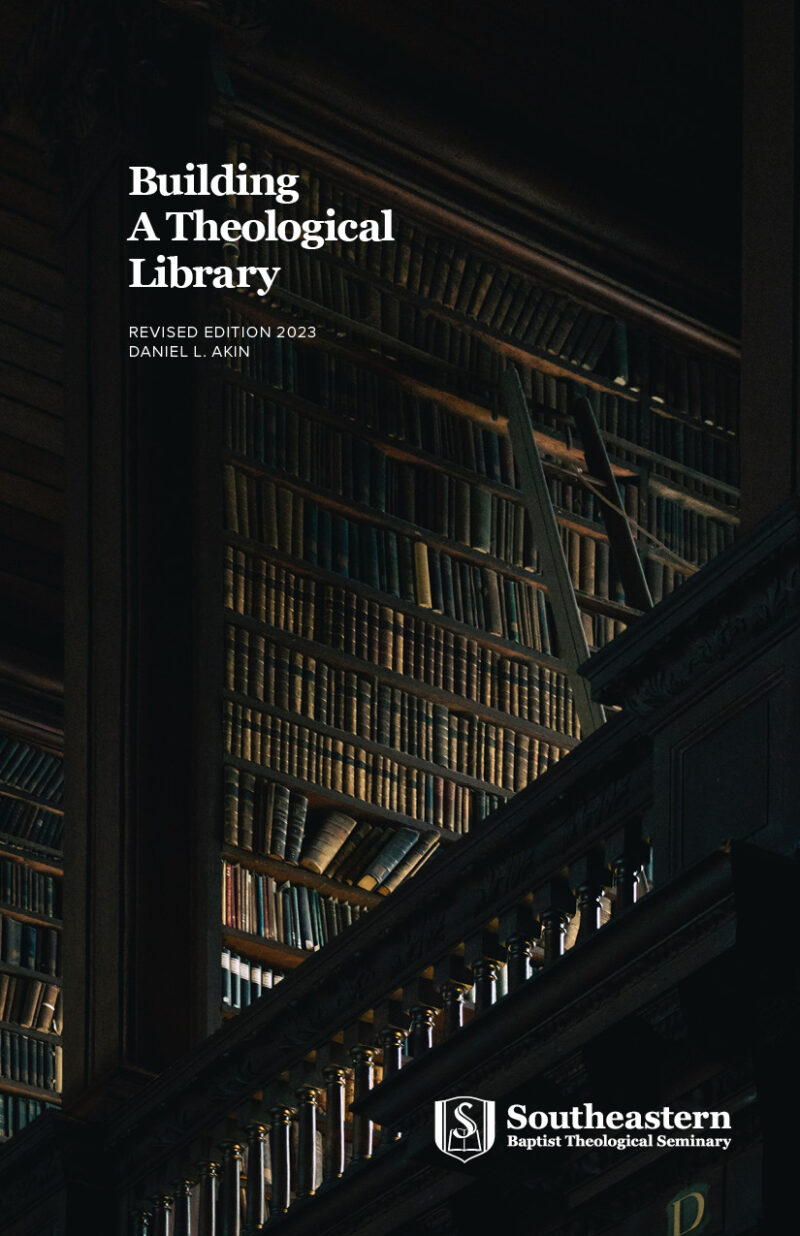
Yet another professor pointed out the importance of words for the Christian faith. The Triune God is himself a model of accomplished communication. God created the universe through his Word (Heb 11:3). Jesus Christ is the living Word (Jn 1:1). The Spirit inspired the written Word and brings enlightens us as we read and meditate upon it. God has given us, his image-bearers, the unique ability to communicate through the written word, and has chosen to speak to us through it. To read is to image forth the Creator. In fact, as Danny Akin’s booklet, Building a Theological Library, points out, “as the apostle Paul faced his impending death, he still remained a student, requesting of Timothy that he bring the books when he came to visit him in prison (2 Tim 4:13).

In the following posts, I will seek to give brief answers to three questions: (1) What should I read? (2) How should I read? (3) What benefits are accrued from disciplined reading? Just for fun, I might include a few lists of “favorite books” in various categories.

Bookmark and Share

Tags: Books, Brad Pitt, Danny Akin, reading, Russ Bush

19 Comments »

  1. My love for reading has been growing in conjunction with the size of my family. Maybe you can post on how to make the best time for reading with 4 kids ages 8 and under. I’ve always wished for a 28-hour day or a pill that requires that I don’t have to sleep, but those will probably come out about the same time as the “get there” magical car teleportation travel button.

    Comment by Sterling Griggs — June 9, 2009 @ 8:04 am

  2. I love this idea for a blog series! I just started seminary as an older student who has been in the workforce for a bit. At 33, I already have well-established reading habits fostered by a degree in the biological sciences (where regular, voluminous digestion of the primary literature was paramount). I’ve been encouraged to realize how well this habit will serve me in seminary. One small nagging thought though is wither and how one can cull the theological offerings out there, and how much to balance reading between theological books and journals. Also, how to “capture” those articles, book chapters, PDFs from the theology library, with bibliographic software tools, etc. so they can be profitably retrieved in the future to serve preaching and academic needs.

    Comment by Matthew — June 9, 2009 @ 9:52 am

  3. Bruce, I love the scripture reference! I love the concept of “serial reader”.

    I believe that we have to read to grow. We need to fill our minds with books, CDs, tapes, podcasts that challenge us.

    I also believe we need to get some good mentors. Some of my best mentors died long ago and left books for me read (Spurgeon, Ravenhill, … Charles Schultz) Others are still writing, and though I’ve never met them, they are mentors in my life.

    A couple of questions:
    1. With so much good material on the Internet now, is it so important to have a good physical library?

    2. What about the pastor that moves, or goes on the mission field? Maintaining a large library is a challenge.

    3. What do you think about audiobooks & podcasts? Is something lost by not being a “book reader”?

    I look forward to this series and to your comments.

    Comment by Jeff Fisher — June 9, 2009 @ 10:03 am

  4. Dr. Ashford,

    Especially if you are writing primarily to seminary students, I think it would really serve us if you would include some advice on how to become a “disciplined reader” without becoming a “dutiful reader” or a “joyless reader”.

    As a seminary student, I certainly know that I need a lot of help in that area.

    Thank you
    -Lee

    Comment by Lee Wilson — June 9, 2009 @ 11:18 am

  5. The fact that this post is tagged “Brad Pitt” is deeply disturbing to me.

    ;-)

    Comment by Greg Welty — June 9, 2009 @ 1:15 pm

  6. Dr. Ashford is a pretty disturbing guy, Dr. Welty.

    NAF

    Comment by Nathan Finn — June 9, 2009 @ 1:55 pm

  7. Hey Dr. Ashford,

    I second Lee’s request. On an intellectual level, I accept the value of being a “serial reader”, but frankly, my time in seminary drove away the great love of reading I had prior to enrollment. In the last several years, I have picked through a book here and there, but I still struggle to find any desire to return to regular, disciplined reading. I look forward to your future posts.

    b.

    Comment by Brian Rolfe — June 9, 2009 @ 4:25 pm

  8. Sterling, I wish I could help you with that one, man! Have you tried to give them a little Benadryl and put them down for a two hour nap? Grin.

    Matthew, great questions. I’ll try to conver some of them, and maybe all, in the next three installments. Especially the journals and books.

    Jeff, I like to hold a book in my hands, mark it up (w/ a pencil and ruler), and put it on a shelf. The only legit exception to that, for me, would be if I move overseas. But that nothing more than my personal preference.

    Lee, as for joyless reading: I’ll have to ponder that one. Maybe if I can come up with a helpful thought or two, I can add an installment dealing with your questions…

    Greg and Nathan, the two of you are scoundrels and I have no witty reply to match your comments.

    Brian, thank you for the encouragement. Maybe I can speak to your (and Lee’s) comments in a future post.

    Comment by Bruce Ashford — June 9, 2009 @ 8:10 pm

  9. Dr. Bruce, (Sorry, not sure what to call you here!)
    In one of his sermons on the new atheism, Dr. Mohler talked about how Stephen Hawking’s “A Brief History of Time” was bought by thousands of thousands of people who never read it. They just bought it because it was the book to own, not necessarily the book to read. It does look impressive sitting on the bookshelf! Maybe that’s Category #4: People Who Buy Books and Want to Read But Never Really Do. I confess my stack is rather large.
    Dean

    Comment by Dean — June 11, 2009 @ 9:17 am

  10. Dean, that is a great point! Maybe I should come up with a Category #4! And I don’t blame most people for not working through Hawking’s Brief History.

    Comment by Bruce Ashford — June 11, 2009 @ 3:33 pm

  11. [...] his first post he said that there are three kinds of people: (1) those who do not read; (2) those who read but do [...]

    Pingback by Disciplined Reading « — June 18, 2009 @ 10:04 am

  12. Thank you for posting this online for others to read! I learned about this post from Between Two Worlds. See my comments there.

    As for me, I wish that I can afford to go to college for my BS or BA. I long for that in Biblical Study Major with English/Journalism Major.

    So, therefore, I can afford to buy some books be able to read them and eating His Word.

    Right now, I am currently reading The Confessions of St. Augustine, Bible Doctrine by Wayne Grudem and ESV for me to eat His Word.

    I don’t read trashy stuffs that is going on out in the world. I don’t even watch TV and do have an 1978 TV without closed caption (I don’t know if the TV is still working or not). The only time I watch TV is when I am at my friend’s house to watch UNC-Carolina ballgame :) .

    I am looking forward to read the next posts about Disciplined Reading!

    Hungry to eat His Word,
    ‘Guerite ~ BoldLion

    Comment by 'Guerite ~ BoldLion — June 19, 2009 @ 12:20 pm

  13. [...] On Disciplined Reading [...]

    Pingback by Read This Post on How to Read. « BRYANLOPEZ.COM — June 19, 2009 @ 12:33 pm

  14. [...] On Disciplined Reading [...]

    Pingback by On Disciplined Reading « One Resolve — June 19, 2009 @ 1:00 pm

  15. Guerite ~ Bold Lion, thank you for taking the time to read and comment!

    Comment by Bruce Ashford — June 19, 2009 @ 4:24 pm

  16. [...] On Disciplined Reading [...]

    Pingback by Reading « The Wanderer — June 22, 2009 @ 3:26 pm

  17. [...] five helpful posts on disciplined reading, which I have linked below. You should check them out. On Disciplined Reading On Disciplined Reading (Pt. 2): What should I read? Choosing from a Vast Array of Options On [...]

    Pingback by On Reading… « Simply Sparks… — June 25, 2009 @ 10:39 am

  18. [...] On Disciplined Reading [...]

    Pingback by Disciplined Reading « Radical Discipleship — July 15, 2009 @ 6:09 am

  19. [...] illiteracy means they can read but not with very much comprehension. Of those who can read, many choose not to read much at all. This will have a huge impact on the churches of the [...]

    Pingback by Story Strategy « 24.14 — July 16, 2009 @ 7:02 am

Leave a comment

Southeastern Baptist Theological Seminary
Recent Posts
  • Kevin Ezell Nominated as President of North American Mission Board
  • Kevin Ezell and NAMB: A Great Day for Southern Baptists
  • On the Dangers of Seminary (Pt. 8): The Danger of Missing Out
  • On the Dangers of Seminary (Pt. 7): On the Danger of Being THAT GUY
  • Toward a Confessional Basis for Cooperation in the SBC: Some Preliminary Thoughts
Categories
  • Books
  • Culture
  • Current Affairs
  • Family
  • Global Affairs
  • History
  • Humor
  • Ministry
  • Mission
  • Public Square
  • SBC
  • Theology
  • Uncategorized
Archives
  • September 2010
  • August 2010
  • July 2010
  • June 2010
  • May 2010
  • April 2010
  • March 2010
  • February 2010
  • January 2010
  • December 2009
  • November 2009
  • October 2009
  • September 2009
  • August 2009
  • July 2009
  • June 2009
  • May 2009
  • April 2009
  • March 2009
  • February 2009
  • January 2009
  • December 2008
  • November 2008
  • October 2008
  • September 2008
  • August 2008
  • July 2008
  • June 2008
Today's Scripture

Ecclesiastes 9-12

view complete list

Bookshelf
McKenzie.IdolatryInPentateuch.86070 K-berger Kellum_ Cradle Cross Crown Lawless 40 Questions about Interpreting the Bible

© 2008 - 2010. Between The Times. All rights reserved. Web Design by FullThrottle Development.